Thursday, February 17, 2011

The Glass Castle


Title:
The Glass Castle
Author: Jeannette Walls
Genre: Memoir
Pages (words): 288 (N/A)
Readability: N/A
Rating (out of 5 stars): ****1/2
Reviewed by: Ben
Description: Jeannette Walls tells her own story of growing up with an alcoholic father and eccentric (to put it mildly) mother in abject poverty. The family is constantly running from the authorities, sleeping in boxes, and going for days without food. Somehow, the kids get raised without dying from illness or accident, but along the way they are subjected to harrowing adventures and heart-breaking ridicule.
Thoughts: I was this close to giving this book five stars. I really loved it. In fact, I think if I had read this book before Angela's Ashes I probably would have given this one five stars and Angela's Ashes would have gotten four and a half. Add A Tree Grows in Brooklyn to that list as well. All three books tell essentially the same story, and all three are excellent books. I'm not sure what is so compelling about reading about kids surviving poverty...maybe it's the fact that these are people who actually did live the idealized American Dream, or maybe it's just the absolute insanity of it all. Whatever it is, The Glass Castle definitely belongs among the best memoirs about going from rags to riches. I couldn't believe some of the things that Jeannette's parents put their kids through; the stories were just wild. But beyond just being a bunch of good stories, what intrigued me about The Glass Castle in particular was the fact that, despite being the worst parents of the century, many of the things her mom and dad said I completely agreed with. The book was filled with tender moments when you could see her dad really trying to develop a close connection with his daughter, and then on the next page he would be using her to get booze money. Her mom was incredible at adjusting to difficult circumstances--something that I believe is an important skill--but so much so that she never made her situation any better. Anyway, I'd highly recommend this book to anyone. Well-written, a real page turner, and chock full of intriguing issues to think about.
Disclaimer: There are several adult moments in the book including two attempted rapes and some sexual abuse. Never is the book overly explicit, nor did it make me feel too uncomfortable. Also, Jeannette's dad uses a fair amount of colorful language.

Thursday, January 27, 2011

I'll Mature When I'm Dead


Title:
I'll Mature When I'm Dead: Dave Barry's Amazing Tales of Adulthood
Author: Dave Barry
Genre: Humor
Pages (words): 272 (N/A)
Readability: N/A
Rating (out of 5 stars): ****
Reviewed by: Ben
Description: A collection of all-new humor essays by Dave Barry, covering topics ranging from having kids to getting a colonoscopy to writing a movie script. And everything in between.
Thoughts: I love Dave Barry. All in all, he's probably the funniest humor writer that I've read, which isn't saying much because anytime I'm in the mood to read humor I pretty much always read Dave Barry. At any rate, I thought this was an absolutely hilarious book. My absolute favorite part was his spoof of Twilight, which was spot on perfect. The only downside of this book was that I was listening to it on the bus, and it was awkward having everyone watch me while I laughed out loud every minute or two. I got over that pretty quickly and just enjoyed the book.
Disclaimer: Dave Barry is relatively clean, but he does have a fondness for bathroom humor. I don't recall many swear words, but there might have been one or two.

Sunday, December 26, 2010

Manhood for Amateurs


Title:
Manhood for Amateurs: The Pleasures and Regrets of a Husband, Father, and Son
Author: Michael Chabon
Genre: Non-fiction essays
Pages (words): 336 (N/A)
Readability: N/A
Rating (out of 5 stars): ****
Reviewed by: Ben
Description: This book is a collection of essays dealing with the topic of manhood. In them, Chabon tells about living through the divorce of his parents, his relationship with his brother, finding the right woman to marry, and his struggles at being a good father. He also covers general topics, such as the lost freedom of childhood and his difficulties of dealing with religion.
Thoughts: I wasn't sure what to expect from Manhood for Amateurs, but I really liked it a lot. The best part about it was the actual writing; Chabon is a great writer. So, regardless of the subject matter I found it nice just to listen to the book. In addition, I really liked a lot of his insights into the struggles and pleasures of being a man. I didn't really agree with everything in the book, but it was enlightening to read and consider. I particularly liked his thoughts on the lost freedom of childhood. Overall, it was a really nice book, and one I would recommend to both men and women. I would have given the book an extra half star if it had not included a fairly significant section on him losing his virginity, which was neither enlightening nor necessary to the book. I really could have just done without that part--not that it was too graphic, but just not really tasteful, in my view. So, my recommendation is that you skip the portion of the book entitled "Burning Women," and read the rest.
Disclaimer: In addition to the section on losing his virginity, there are also a fair number of swear words in the book.

Tuesday, December 21, 2010

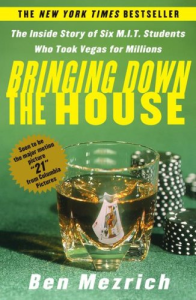
Bringing Down the House


Title:
Bringing Down the House: The Inside Story of Six M.I.T. Students who took Vegas for Millions
Author: Ben Mezrich
Genre: Nonfiction (kind of)
Pages (words): 273 (78,076)
Readability: 7.3
Rating (out of 5 stars): ***
Reviewed by: Ben
Description: In the mid-1990s, a team of MIT students mastered the art of team card-counting, and then took their game to Vegas. This book details their experiences, the double lives they led, the money they made, and their struggles against the casinos to stay in the game.
Thoughts: This was an enjoyable read, but nothing earth-shattering. The subject of the book is completely fascinating: super-smart people leading double lives, wearing disguises, taking on fake identities, and using their brains to win nearly $4 million from Vegas casinos. It doesn't get much better than that, really. However, I didn't really love Mezrich's writing style, and I really could have done without some of the strip club scenes. All in all, a fun book, but not one I'll readily tell everyone to read.
Disclaimer: This book has a lot of swearing, wild parties, strip clubs, etc. A little more than I was comfortable with, really.

Soccernomics


Title:
Soccernomics: Why England Loses, Why Germany and Brazil Win, and Why the U.S., Japan, Australia, Turkey--and Even Irag--Are Destines to Become the Kings of the Worlds' Most Popular Sport

Authors: Simon Kuper & Stefan Szymanski

Genre: Popular Economics
Pages (words): 336 (N/A)
Readability: N/A
Rating (out of 5 stars): ****
Reviewed by: Ben
Description: Kuper, a sport journalist, and Szymanski, a sports economist, use cold, hard data to tackle questions regarding commonly-held beliefs about soccer. Ranging from what determines a country's success in major tournaments to how purchase a player for your team to the game theory behind the penalty kick, they show that many of the "truisms" of soccer are actually wrong. They have the data to prove it.
Thoughts: I'm kind of hit-and-miss on the extent to which I like popular economics books like Freakonomics. But you couldn't find a book better suited to my particular tastes than Soccernomics. I follow U.S. soccer relatively closely, and I think to myself very often that I would love to have the data to test a few ideas. In this book, Kuper and Szymanski do that for me. I really loved the book, and I even thought that the economics they used were sound for the most part. That being said, this book really isn't for everyone. In fact, if you're not a relatively big soccer fan, you probably wouldn't enjoy it. But I loved it!
Disclaimer: None.

Thursday, December 02, 2010

Mockingjay


Title:
Mockingjay (Hunger Games, Book 3)
Author: Suzanne Collins
Genre: Young Adult Science Fiction
Pages (words): 400 (N/A)
Readability: N/A
Rating (out of 5 stars): ****
Reviewed by: Ben
Description: The conclusion of the saga of Katniss Everdeen and her fight against the Capitol. I can't say much more without spoiling things if you haven't read the previous books in the series!
Thoughts: I thought this was a great conclusion to the Hunger Games series. I'm so glad that the series didn't devolve into a hopeless love triangle (I'm looking at you, Twilight books), and that instead there were many more issues involved than just Katniss' relationships with Gale and Peeta. I was also glad that the plot didn't pull any punches; several important characters are killed along the way, and many others are permanently affected. Although the book was pretty brutal, the brutality made the book less predictable and, hence, more captivating for me. I was even glad that there wasn't really a "happily ever after" ending, but instead more of "pick up the pieces and move on" conclusion. The writing wasn't great by any means, but the plot really moved along enough to keep me fully absorbed and excited for each chapter. All in all, I really enjoyed the whole Hunger Games series (especially the second and third books), and would recommend it to anyone who is looking for a quick, engrossing read.
Disclaimer: The book is pretty gory, and it might have a few swear words, but I can't recall anything too major.

Saturday, November 20, 2010

Tess of the d'Urbervilles


Title:
Tess of the d'Urbervilles
Author: Thomas Hardy
Genre: Classic
Pages (words): 384 (148,121)
Readability: 8.8
Rating (out of 5 stars): ****
Reviewed by: Ben
Description: Tess Derbyfield has grown up very poor for her whole life. When her father learns that they are actually related to the ancient noble line of the d'Urbervilles, he sends her off to visit some long-lost (and rich) "cousins" who may just provide them with a better living. Instead of finding a better life, however, Tess instead finds a harsh world in which people are self-centered and prejudiced to the extreme, with disastrous consequences resulting for all involved.
Thoughts: I really liked this book a lot. Hardy does an incredible job of highlighting the weaknesses that many of us have. Where one man cannot overcome his appetites and passions, another man cannot overcome his prejudices. At the end of the book, I'm still left wondering which was worse, overall. Anyway, that's what I loved about the book. The plot itself was good also (if a little far-fetched), but I had already seen a BBC version of the story so there were no real surprises in it for me, which was unfortunate, as I think I would have liked it even more if I didn't know what was coming. All in all, I really highly rate this lesser-known classic.
Disclaimer: Deals with adult ideas, but it's very clean.

Saturday, October 30, 2010

Catching Fire


Title:
Catching Fire (Hunger Games, Book 2)
Author: Suzanne Collins
Genre: Young Adult Science Fiction
Pages (words): 391 (N/A)
Readability: N/A
Rating (out of 5 stars): ****
Reviewed by: Ben
Description: If you haven't read this series, I don't want to spoil it for you, and if you have, you've probably already read this one! Basically, it picks up right where The Hunger Games left off, with Katniss and Peeta thrown together once again in a quest to thwart the Capitol and stay alive in the process.
Thoughts: I didn't give a stellar review to The Hunger Games because for whatever reason I kind of got tired of it about 3/4 of the way through. That was absolutely not the case with this one. This book opened up so much more depth to the full plot; there was a lot more to think about than just Katniss' difficulty in managing her love triangle with Peeta and Gale. Towards the end, when I realized that there was a whole lot more going on than just Katniss trying to stay alive, the book was really entrancing--I had a hard time putting it down, and was really bummed when I tried to check out the last book in the series from the library and found out that there were 58 people ahead of me in line! This was a really great follow-up to The Hunger Games, and I can't wait to read the last one. (Never fear, I got a free trial at Audible.com and downloaded the last book. I'm about 1/4 through it now!).
Disclaimer: There is a fair amount of gore in this book, but that's it. Pretty clean.

Friday, September 17, 2010

Why Gender Matters


Title:
Why Gender Matters: What Parents and Teachers Need to Know About the Emerging Science of Sex Differences
Author: Leonard Sax, M.D. Ph.D.
Genre: Non-fiction (Science/Parenting)
Pages (words): 336 (N/A)
Readability: N/A
Rating (out of 5 stars): ****
Reviewed by: Ben
Description: Leonard Sax describes the major differences between boys and girls both in terms of their psychology as well as their physiology, and explains how those differences can make a huge difference in the way they should be taught, mentored, and parented. Carefully studied with plenty of citations, Sax mixes plain scientific observation with some of his recommendations on how to apply the knowledge in a practical way. To give a simple example, he cites several studies that show that boys' hearing is on average substantially worse than girls'. So, he suggests placing boys near the front of the classroom and talking to them louder. There are a multitude of examples such as this that really give one a clearer idea of how to work with gender differences.
Thoughts: I really enjoyed this book, and felt like it was an important one for me to read as a parent (as well as a future professor). There were lots of insights and aha moments as I read it. The most incredible thing to me was that the Church already does basically everything that he suggests in the book (e.g. encourage families to eat together, give solid boys-only and girls-only mentoring and teaching, etc.). Still, there were lots of things I could personally take from the book that alters the way I approach parenting situations. While I didn't agree with everything in the book, nearly all of it was spot-on and very well researched. I think every parent should read this book. I'm already planning on reading his next one, Boys Adrift.
Disclaimer: The chapter on sex was quite explicit. In my opinion, completely unnecessarily so--there was way too much detail in there for what was needed. Not sure if he was just going for the shock effect or what, but I could have done with that part being toned down several notches. Besides that, it was clean.

The Hunger Games


Title:
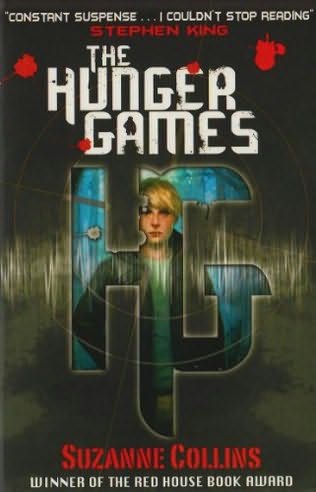
The Hunger Games
Author: Suzanne Collins
Genre: Young Adult Science Fiction
Pages (words): 384 (N/A)
Readability: N/A
Rating (out of 5 stars): ***
Reviewed by: Ben
Description: In a future world, the central government of what used to be the United States mercilessly oppresses the outlying districts and favors the citizens living in the Capitol. As a reminder to the Districts of its superiority, the Capitol holds the annual Hunger Games, in which 24 teenagers are randomly selected, placed in an arena, and the last one living wins. Katniss Everdeen, a 16-year-old girl from District 12, volunteers to go to the Games in place of her sister. Will she survive? How will she do it?
Thoughts: There has obviously been a lot of hype about the Hunger Games books. This one really sucked me in for about the first 3/4 of the book, but then I started to grow tired of it by the end. I'm not really sure why, because everyone else that I know who has read it has finished it in like a day and can't wait to read the next one. My take on it is that it was a lot of fun and I'll definitely finish the series, but I wasn't totally engrossed like everyone else seems to be. The basic plot is a great idea, but the writing is only fair and it seems a bit formulaic here and there. Still, I'd recommend it to anyone looking for a fun book that will really suck them in.
Disclaimer: Obviously, there's some gore in this book, but nothing major.

Thursday, August 12, 2010

SuperFreakonomics


Title:
SuperFreakonomics
Authors: Steven D. Levitt & Stephen J. Dubner
Genre: Popular Science
Pages (words): 288 (N/A)
Readability: N/A
Rating (out of 5 stars): ****
Reviewed by: Ben
Description: Levitt (a U. of Chicago economist) and Dubner (a journalist) team up once again to explore "the hidden side of everything." In this sequel, they examine data on prostitutes, doctor performance, the impact of television on women in India and childen in the U.S., the effectiveness of car seats, the dangers of walking drunk, and global warming, applying good economic thinking to each question to see what the data say.
Thoughts: If you liked Freakonomics, you'll like this book. I personally liked this one better than the first, but both are really good. Some of the things they talk about in this book I've already run across in various economics classes, but I still enjoyed hearing about them in a very accessible way, and there were plenty of surprising findings in there as well. But what I really liked about SuperFreakonomics (and its prequel) is that it is a great way to learn a bit about what most academic economists actually do for their research. In the news most people hear a lot from macroeconomists who opine on the direction of the economy and financial markets. In reality, though, more and more economists spend their time doing microeconomics, and this book gives a good glimpse in to what that actually is: asking an interesting question and then coming up with a clever way to find an answer. I think most people will find that micro is much more interesting than macro!
Disclaimer: There are several swear words, and the entire first chapter deals with the economics of prostitution. It's all quite clean, but probably not a topic for the kiddos.

Pilgrim at Tinker Creek


Title:
Pilgrim at Tinker Creek
Author: Annie Dillard
Genre: Philosophy
Pages (words): 304 (88,994)
Readability: 9.2
Rating (out of 5 stars): ****
Reviewed by: Ben
Description: Annie Dillard ruminates on living a full year in a cabin near Tinker Creek, a small stream in Virginia. Much like Thoreau's Walden, Pilgrim at Tinker Creek uses observations on nature to make much larger points. Dillard talks about everything from tracking muskrats to the art of listening, but throughout all of it she is really focused on how man can find God, if He really exists.
Thoughts: For me, this book started out as a five-star book, then fell to three, and then ended up meriting four stars. Dillard is really an incredible writer, and she certainly has a knack for pulling meaning out of things that I never could have. There were parts of the book that I enjoyed very, very much, and some parts that I thought were a little bit too "out there" for me. I wish that I had known beforehand how the book was structured; the first half is about the beautiful things that exist in nature that signify there is a God, while the second half is about the awful things that one must cut away in order to find God. Not knowing this (until Dillard explained it in the epilogue), I couldn't figure out why the second half of the book was so unlike the first. I probably would have enjoyed it more had I known that going in to it. Overall, this book was definitely a worthwhile read, and I'll be looking in to reading some more Dillard in the future.
Disclaimer: None.

Sunday, July 25, 2010

Angels & Demons


Title:
Angels & Demons
Author: Dan Brown
Genre: Thriller
Pages (words): 496 (N/A)
Readability: N/A
Rating (out of 5 stars): ****
Reviewed by: Ben
Description: Robert Langdon is a Harvard Professor of symbology who gets called to Europe to help solve a murder mystery. The trail of the murderer is marked by ancient symbols which lead him across Rome in a quest to save the Vatican.
Thoughts: The perfect summer-reading kind of a book. This book was a real page-turner and I really enjoyed it all the way through. There were enough twists to keep me guessing all the way until the end, and the way that Brown weaves history, art, religion, and science together really is impressive. A little implausible, but impressive just the same. I would say that the only knock on the book was that it is pretty similar to The Da Vinci Code, but that's why I read it in the first place, so I shouldn't complain. Guess I'll have to read The Lost Symbol the next time I get in the mood for this kind of a book!
Disclaimer: This book was pretty gory. Several people are killed in really gruesome ways. I don't recall too many swear words, however.

Friday, June 25, 2010

Outliers


Title:
Outliers: The Story of Success
Author: Malcolm Gladwell
Genre: Popular Science
Pages (words): 309 (N/A)
Readability: N/A
Rating (out of 5 stars): ***1/2
Reviewed by: Ben
Description: Following up on the success of The Tipping Point and Blink, Gladwell's third book explores just what makes some people extraordinarily successful. He examines the stories of professional athletes, rock stars, and millionaires and looks for key moments in their lives when they got their chance to make it big, and how those opportunities came about. In the end, he relates this to our lives and thinks about what we might do to promote even more success stories.
Thoughts: I like to read Gladwell's books. He basically tells a bunch of stories and summarizes a bunch of research and tries to tell a coherent story throughout it all. He does a great job of finding and summarizing the studies and stories (they're all fascinating), but at times I think he falls a bit short in being able to pull it all together in to one big theme,. Outliers was no exception to this, but overall it's probably my favorite of the three big ones he's written. And, I think that for the most part he makes good points. The main one, and I'm probably not giving too much away here, is that people become extremely successful not because they are that much better than everyone else, but because they had an opportunity that most other people never had and they made the most of it. That's something that I truly believe. I also especially liked the portion near the end of the book about how one's culture can really define what a person excels at, despite whatever talents they were naturally born with. To whet your appetite, he claims that the Chinese are generally good at math mainly because of the culture they grew up in, and especially because of the language they speak. And I actually buy his argument. Anyway, it was a fun little book, it gave me a lot to think about, and I enjoyed reading it.
Disclaimer: I think there were a few swear words in this book, but nothing too major.

Tuesday, June 22, 2010

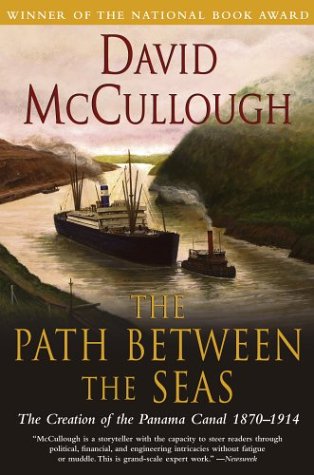
The Path Between the Seas


Title:
The Path Between the Seas: The Creation of the Panama Canal
Author: David McCullough
Genre: History
Pages (words): 698 (227,244)
Readability: 12.4
Rating (out of 5 stars): ***1/2
Reviewed by: Ben
Description: A shortcut from the Atlantic to the Pacific was dreamed of for hundreds of years before the Panama Canal was built. Multiple expeditions set out to determine whether the feat was even possible, and, if so, where the best route lay. McCullough lays out the attempt of the French at building the canal, and the subsequently successful efforts of the Americans to connect the oceans. The entire book covers over 40 years of history.
Thoughts: Every David McCullough book I read, I think to myself, "Why has no one ever told me this before?!?" This book was no exception. All the way though it, I couldn't believe that I knew basically nothing about the building of the Panama Canal. About all I knew was that it was built by the U.S. (I had no idea the French tried it first). Anyway, this was a great book, as all McCullough books are. I especially loved the engineering parts that described the building of the locks and how they overcame the technical issues of connecting two oceans across a continent. Because I can't help comparing this McCullough to the others that I've read, I have to say that I've probably liked his other ones a bit more than this one. The Great Bridge (about the building of the Brooklyn Bridge) was a very similar book that I personally enjoyed more than this book. But that shouldn't take anything away from The Path Between the Seas. The book is superbly put together, easy to read, fully of primary-source material, and interesting throughout.
Disclaimer: None.

Sunday, March 28, 2010

A Tree Grows in Brooklyn


Title:
A Tree Grows in Brooklyn
Author: Betty Smith
Genre: Classic
Pages (words): 528 (155,559)
Readability: 5.9
Rating (out of 5 stars): ****1/2
Reviewed by: Ben
Description: Francie Nolan is the daughter of a singing waiter father and a severely practical mother, and is growing up in Brooklyn around the turn of the 20th century. Living in severe poverty, Francie struggles to reconcile her dreams with reality, to learn truth without giving up on her dreams.
Thoughts: Another spectacular book. I recently read both Angela's Ashes and The Book Thief, and I would put A Tree Grows in Brooklyn right up there with those two. What makes A Tree Grows in Brooklyn so impressive is that its writing style feels very modern, even though it was written over 60 years ago. Smith is very open about the difficulties of life, and the issues facing the poor, which is rare for a book written in the 1940s. Anyway, the story was really captivating, and even better than that, it brought out an issue that I think we all have to address as we come to face reality: How does one keep their hope alive when they realize that things might not turn out according to their dreams? I really like how the book personified both romance and reality through Francie's parents. I found myself comparing my parenting style to each parent and realizing that I have a bit of both the practical and whimsical in me. Hopefully I can keep walking that line!
Disclaimer: There are a few swear words in the book, and a few of the characters are quite open about their sex lives. Still, overall this is a pretty clean book.

Wednesday, February 24, 2010

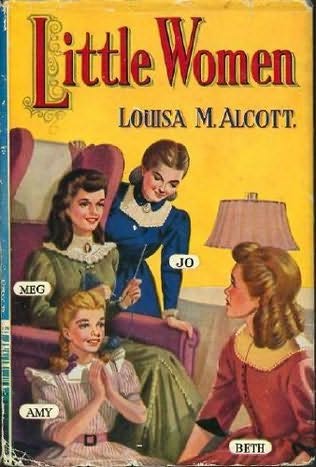
Little Women


Title:
Little Women
Author: Louisa May Alcott
Genre: Classic
Pages (words): 464 (185,716)
Readability: 9.2
Rating (out of 5 stars): ***
Reviewed by: Ben
Description: Not sure this one needs much of a description. Little Women is the classic story about four girls coming of age in a little New England town. Together, they learn tough lessons about life and what it truly means, with much guidance from their loving mother.
Thoughts: I didn't expect to really love this book, since I'm not really the target audience. And, overall, it was about what I expected: entertaining, good plot, lots of great morals, but just not really intriguing for me. I think the issue was that there wasn't really a character that I connected to, and since I already knew the basic story there just wasn't much that captured my attention. I do have to say that the writing was better than I expected, which made the book pretty enjoyable. All in all, I'm glad that I read it (especially with Alcott's home just a few miles from our house!), and I'd definitely recommend it to everyone.
Disclaimer: Pretty tame book overall. :)

Tuesday, January 05, 2010

2008-2009 Books in Review

It has been two years since my last "Books in Review" post, so I think it's time for another update. I read 24 books in 2008-2009, so this post will give my picks of the best books in that group. I'll also give some numbers that summarize my reading habits, but I'll save that for the end of the post because it's probably more interesting to me than to anyone else.

My top three books from the past two years are:

East of Eden (Classic), How Green Was My Valley (Classic), and The Book Thief (Modern)

Not surprisingly, these are the only three books that I gave 5 stars to out of the 24 I read over the past two years. Of course, they are highly recommended! If you're wondering, my top three picks from two years ago were My Antonia, My Name is Asher Lev, and These Is My Words.

In addition to the above three books, I also wanted to throw out a few honorable mentions (organized by genre):

Memoir: Angela's Ashes
Mystery: The Moonstone
Non-fiction: Joseph Smith: Rough Stone Rolling
Non-fiction: Nudge: Improving Decisions about Health, Wealth, and Happiness

What was the worst book I read in the past two years? Don Quixote. In retrospect, I can't believe that I suffered through 29 CDs (415,800 words!) of that book. No one part of Don Quixote was that bad, and some parts I really enjoyed, but it should have been 1/5th of the length. It just never ended. Not worth the effort.

Now, for the more numbers-oriented, here are some summary statistics of the 24 books. Keep in mind that I was only able to get number of words and reading grade level for 14 of the 24 books (I get both numbers through Amazon's "Text Stats" feature, which isn't available for all books), so it's a small sample:

Average Length, pages: 410.3
Average Length, words: 138,457
Average Reading Grade Level: 7.9
Average Rating: 3.7 stars
Average Rating by genre:
Classics (7 books): 3.8 stars
Memoirs (3 books): 3.7 stars
Modern (4 books): 3.8 stars
Mystery (1 book): 4.5 stars
Non-fiction (8 books): 3.6 stars
Young Adult (1 book): 3.5 stars

I was also curious to see how these stats look when I combine all of the books that I've read since 2006. When I combine these 24 books with the 31 books from my last "Books in Review" post, the stats look like this:

Average Length, pages: 370.3
Average Length, words: 108,581
Average Reading Grade Level: 7.5
Average Rating: 3.6 stars
Average Rating by genre:
Classics (15 books): 4.1 stars
Fantasy (5 books): 3.3 stars
Memoirs (5 books): 3.4 stars
Modern (8 books): 4.0 stars
Muckraker (1 book): 4.0 stars
Mystery (5 books): 3.0 stars
Non-fiction (13 books): 3.5 stars
Philosophy (1 book): 2.5 stars
Young Adult (2 books): 3.5 stars

So, it looks like I prefer classics and modern fiction to most other genres. I was surprised to see that my non-fiction average rating is only 3.5 stars, since I think I really enjoy most of the non-fiction books that I read. I guess I just like the fiction books better...

Lastly, I was also interested in whether I tend to like longer or shorter books, or books that are easier or harder to read. Here are some simple correlations:

Correlation of:
Pages with rating: 0.154
Words with rating: 0.077
Readability with rating: -0.103

Based on these numbers, I tend to like longer books slightly more than shorter ones, although when I use the number of words in the book to measure the length the relationship isn't as strong. I also tend to rate hard-to-read books a bit lower. I should note, however, that Don Quixote is a major outlier that skews these correlations because it is so long and also was the most hard-to-read book I've read, with a reading grade level of 15.8. Combine that with the fact that I gave Don Quixote only 2.5 stars, it can mess things up. If I take Don Quixote out, the numbers are,

Correlation of:
Pages with rating: 0.263
Words with rating: 0.260
Readability with rating: 0.012

Now the correlation of length with rating is quite a bit stronger, while the correlation of readability with rating is essentially zero. These numbers are probably more reflective of my true preferences.

Finally, here are the books that I've got on the docket, so this is what you've got to look forward to, if you're interested:
Little Women (about 2/3 done)
A Tree Grows in Brooklyn
The Path Between the Seas

Happy reading!

Wednesday, December 23, 2009

The Witch of Blackbird Pond


Title:
The Witch of Blackbird Pond
Author: Elizabeth George Speare
Genre: Young Adult Fiction
Pages (words): 256 (60,212)
Readability: 5.3
Rating (out of 5 stars): *** 1/2
Reviewed by: Ben
Description: In 1687, Catherine Tyler leaves her home in Barbados to live with her aunt and uncle in rural Connecticut, where she struggles to assimilate in to the strict Puritan community. She learns how to cope with her new situation by associating with another outcast of the Puritan society, an old Quaker women named Hannah. Together, they learn to strike a balance between doing what society expects, and doing what they know is right.
Thoughts: It took me a while to get in to this book, but by the end I really enjoyed it. It really does a great job of demonstrating how prejudice can creep up and the terrible consequences that can result. My only complaint would be that everything gets tied up too neatly at the end, but it's a young adult book so I kind of expected that. If you're in the mood for a quick, easy read (or if you're about 12 years old or so!), you should check this book out.
Disclaimer: None.

Thursday, November 26, 2009

A Connecticut Yankee in King Arthur's Court


Title:
A Connecticut Yankee in King Arthur's Court
Author: Mark Twain
Genre: Classic
Pages (words): 474 (N/A)
Readability: N/A
Rating (out of 5 stars): ***
Reviewed by: Ben
Description: Hank Morgan, a Yankee living in Connecticut in the late 19th century, gets transported back 13 centuries when he is hit on the head, ending up in 6th century England. He soon finds himself right in Camelot, complete with King Arthur and the Knights of the Round Table. Being a resourceful Yank, he wastes no time in using some common sense and 13 centuries' worth of knowledge to establish himself as a powerful magician and as the King's right-hand man. With his influence, he constructs some 19th-century amenities, including electricity and the telephone. But when he tries to make things better for the commoners, he meets with some serious opposition.
Thoughts: As will all Mark Twain books, A Connecticut Yankee is an enjoyable book. Twain has a great voice in his writing that is a pleasure to read. But beyond that, I can't say that I loved this book. It was entertaining and it brought out some interesting points (e.g. religion can be as bad as slavery), but much of it seemed a bit forced, like the book was simply a pretense for Twain to get out a lot of pent-up anger about society. The plot seemed like it was just draped over Twain's checklist of things that could be better about society. I don't mind an author writing books with a message in mind--in fact, I prefer it--but there are other Twain books that get his ideals across better than A Connecticut Yankee. Overall, if you're considering reading this book, my advice wouldn't be, "Don't read it," it would just be, "Don't start here." The Prince and the Pauper covers many of the same ideas and was better than this one, and of course Huckleberry Finn and Tom Sawyer are both incredible Twain books.
Disclaimer: None.

Sunday, November 15, 2009

The Book Thief


Title:
The Book Thief
Author: Markus Zusak
Genre: Modern Fiction (set in WWII)
Pages (words): 576 (N/A)
Readability: N/A
Rating (out of 5 stars): *****
Reviewed by: Ben
Description: At 9 years old, Liesel's mother can no longer care for her, and she is sent to a foster home. The Book Thief tells about her coming of age in Nazi Germany: how she grows to love her foster parents, how she begins to understand prejudices, and how she learns about the power of words to do both good and evil.
Thoughts: For me, this book had it all. First, I thought the writing was fantastic. Zusak has Death narrate the story, which is an interesting and very effective way to convey the story. His descriptions are incredibly vivid and fresh, and several parts of the story were really quite funny, although the book itself isn't. Second, the plot was great. I love that the book is not about a Jew in Nazi Germany, or the allied forces in Nazi Germany. It is about a German girl in Nazi Germany. I have often wondered how so many Germans came to follow Hitler when Hitler was so obviously insane and amoral. I think The Book Thief sheds some light on that question, with the answer being that it didn't take many people to bully the rest into obedience. Anyway, the perspective of the book was interesting to me, and really helped me see a little better the difficulties of the German people under the Nazis. Finally, The Book Thief made me want to be a better person, which is what I'm really looking for in a lot of books. And I think that Zusak pulls that off without being preachy or even too idealistic. The characters are real and they make mistakes, but by the end you're really pulling for them because you can see what makes them good. Put all of that together, and you've got a 5-star book. Highly recommended.
Disclaimer: There is some blood and gore, but this book is pretty clean. There are a lot of German swear words, which didn't bother me because I don't speak German. A few of them get translated in to English, but I didn't think it was too bad.

P.S. A huge thanks to Christina for giving us this book!!

Sunday, October 04, 2009

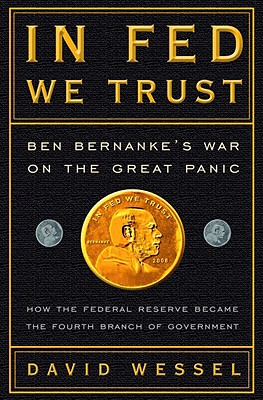
In Fed We Trust


Title:
In Fed We Trust: Ben Bernanke's War on the Great Panic
Author: David Wessel
Genre: Financial Non-fiction
Pages (words): 336 (N/A)
Readability: N/A
Rating (out of 5 stars): ***1/2
Reviewed by: Ben
Description: A narrative of the steps the Fed and the Treasury took to (attempt) to stem the tide of the greatest financial crisis since the Great Depression. Wessel gives the inside scoop on just what was happening inside the Fed as many of these major decisions were being made, and the rationale behind them.
Thoughts: I was surprised at how good this book was. The crisis isn't even over, and Wessel has really put together an impressive account of many of the major events that took place, include interviews with many key people which help give a larger understanding of what was going on behind closed doors while the financial system teetered on the brink. I think it is a pretty fair account as well; he's not overly critical but doesn't heap praise on the main actors either. In the end, Bernanke and Geithner come out looking pretty good, and, given the circumstances, I think they did as well as anyone could have expected them to. If anyone is looking for a non-technical description of just what went wrong over the past two years, and what the government (especially the Fed) did to try to stop it, this is the book to read.
Disclaimer: None.

D-Day


Title:
D-Day: June 6, 1944: The Climactic Battle of World War II
Author: Stephen E. Ambrose
Genre: History
Pages (words): 656 (218,581)
Readability: 8.8
Rating (out of 5 stars): ****
Reviewed by: Ben
Description: A blow-by-blow description of the events that occurred on D-Day.
Thoughts: For a long time I've felt like I knew much less about WWII than I should, which is why I decided to read this book (recommended by my friend Tim). I really enjoyed the book immensely, and I'm disappointed that I was only able to find an abridged version in audiobook format (which means that I didn't read all 218,581 words!). Not only was it meticulously researched, but Ambrose's writing is very good as well. What I enjoyed most was that he pieced the events together by telling a series of personal stories of the men who infiltrated Normandy on D-Day, rather than just giving the facts. This made the book more personal; it helped me understand better the horror and triumph of that day. While I still cannot imagine what it would have been like to have been one of those men coming off the boats and running up the beach, I at least have a very clear picture in my mind of what it must have been like. I'd still like to know more about WWII, but a full understanding of D-Day was a very good place to start.
Disclaimer: There is plenty of blood and gore, as you would guess from a war book. Also a few swear words, but not as many as I feared there would be.

Thursday, September 17, 2009

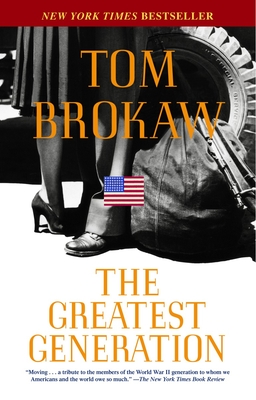
The Greatest Generation


Title:
The Greatest Generation
Author: Tom Brockaw
Genre: History/Memoir
Pages (words): 432 (96,020)
Readability: 10.1
Rating (out of 5 stars): ***1/2
Reviewed by: Ben
Description: The Greatest Generation is about the men and women who were born in the roaring 20's, grew up in the Depression 30's, fought in WWII, and then returned home to found families and begin the most prosperous period of our nation's history. Brockaw believes that this was the greatest generation of Americans ever. Brockaw tells the story of a few of these men and women, mostly focusing on the war and the years afterward.
Thoughts: I really enjoyed the stories of these men and women, how they survived the war, and what they did after returning home to try to forget the past and make up for lost time. While Brockaw is obviously making a huge generalization by claiming that the men and women who lived through WWII were the greatest generation of Americans ever, it's hard to refute his claim. Doesn't it seem like we've lost something since then? Maybe that something is a sense of duty and responsibility, or maybe it's a sense of unity. I'm not sure, but I wish we had it back. It was surprisingly refreshing to hear about the stories of heroism as well as the people (both on the home front and abroad) who just quietly did their jobs. Perhaps it takes a calamity as large as WWII to force a nation to come together like that, or perhaps Brockaw and the rest of us are looking back through history with rose-colored glasses. Whatever the case may be, I really enjoyed reading these stories and learning from the brave people who have gone before me.
Disclaimer: There are a few "war" words, but nothing serious. Also, I listened to the audio version of this book, which is unfortunately abridged down to just 3 CDs, so there is a large chunk that I haven't read.

Nudge


Title:
Nudge: Improving Decisions About Health, Wealth, and Happiness
Authors: Richard Thaler & Cass Sunstein
Genre: Popular Economics
Pages (words): 320 (N/A)
Readability: N/A
Rating (out of 5 stars): ****
Reviewed by: Ben
Description: Thaler and Sunstein begin by laying out a few basic principles of behavioral economics: (1) the power of a default option, (2) the limited cognitive powers of humans, (3) and loss aversion (we hate losses more than we love gains). They then show how these three ideas can lead people to make bad decisions, sometimes very bad ones, and how government and businesses can apply simple "nudges" to push people in better directions. They call this idea "libertarian paternalism," with the idea being that we can preserve freedom of choice, but frame people's choices in a way that are more likely to lead them to better decisions. They then show how to apply this idea to a whole range of issues, including saving for retirement, health care, marriage, mortgages, and credit cards.
Thoughts: I've read several popular science books (Blink, Freakonomics, and The Tipping Point), but this is my favorite to date, hands down. I had a behavioral economics course last year, so I had actually already heard about all of the concepts in the book previously (they are very cool ideas, so I didn't mind reading them again), but the applications that they recommend are just incredibly useful. Here's an example: They found that just by switching the default option on retirement savings so that an employee has to opt out of the company plan rather than opt in results in hugely increased participation rates. I don't remember the exact numbers, but it was something like jumping from 45% to nearly 90%. They go through example after example of this type of situation, showing how simply changing the environment of the decision-maker slightly can helpfully nudge the person towards making much better decisions. I think everyone should read this book, especially Congress. Actually, Sunstein is in the White House now, and I believe that a few of these ideas are actually being pushed by Obama. We can only hope.
Disclaimer: None.

Friday, August 28, 2009

Don Quixote


Title: Don Quixote

Author: Miguel de Cervantes
Genre: Classic
Pages (words): 992 (415,800)
Readability: 15.8
Rating (out of 5 stars): **1/2
Reviewed by: Ben
Description: Don Quixote is a Spanish gentleman who reads too many books of chivalry and goes mad in a very peculiar way: he keeps full use of his sense except when it comes to topics of knighthood. He becomes so befuddled that he soon believes himself to be a knight, and decides to sally forth in search of adventure as knight errant. His madness and courage mixed together lead him on a series of adventures which are to be at once laughed at and admired.
Thoughts: I've always thought that I should read Don Quixote some day, and I don't regret reading it, but it was a major the summer project. There were many parts of this book that I genuinely enjoyed, but 29 CDs is just too long for this story. In fact, my main complaint is that it isn't so much a story as a series of adventures that are only loosely connected, making the book really drag on. Why is it that so many old classics are much too long for their plotlines? (I'm thinking of think Les Miserables and Moby Dick, for example) Is it that our attention spans have gotten shorter, or that they were just overly verbose? Anyway, there is so much rambling that I would often find myself daydreaming as Don Quixote pontificated on the merits of courage or whatever. However, there are a lot of redeeming factors that make the book worth reading if you have a high tolerance for long, rambling books. Much of the book was genuinely funny (the inspiration for Monty Python?), it made a lot of good points, and I enjoyed the characters of Don Quixote and his squire Sancho Panza immensely. My main takeaway is this: Valor and action will get you a long way in this life, even if you are a little mad.
Disclaimer: None.

Wednesday, June 10, 2009

So Brave, Young and Handsome


Title:
So Brave, Young and Handsome
Author: Leif Enger
Genre: Modern Western Fiction
Pages (words): 272 (N/A)
Readability: N/A
Rating (out of 5 stars): ****
Reviewed by: Ben
Description: Monte Becket is struggling to write his second novel when he chances to meet Glendon Hale. They quickly become friends, and Monte agrees to go with Glendon to make amends with Glendon's ex-wife, who lives in Mexico. But the trip takes a wrong turn when they run into the law, and the outlaw Glendon runs for it. Monte gets much more than he bargained for as he becomes deeply involved in Glendon's flight from the law.
Thoughts: I was really excited to read this book, after enjoying Peace Like a River (Enger's first book) a couple of summers ago. So Brave, Young and Handsome did not disappoint. It's been a long time since I read a western, and I thoroughly enjoyed it. Similar to Peace Like a River, Enger's talent lies in storytelling. The prose is perfect, the characters vivid. The difference from Peace Like a River is that this book's plot really moves right along; the type of book that's not easy to put down. Peace Like a River was perhaps more thoughtful, which I also liked. Anyway, So Brave, Young and Handsome is great entertainment, and the perfect summer read.
Disclaimer: A little violence, but overall very clean.

Thursday, May 28, 2009

The Know-It-All


Title:
The Know-It-All: One Man's Humble Quest to Become the Smartest Person in the World
Author: A. J. Jacobs
Genre: Non-fiction Humor
Pages (words): 400 (138,244)
Readability: 8.1
Rating (out of 5 stars): ****
Reviewed by: Ben
Description: A.J. Jacobs, an editor for Esquire, feels like he's on top of the world as far as pop-culture knowledge goes, but in all other areas he's in the shallow end of the knowledge pool.  So, he takes it upon himself to read the Encyclopaedia Britannica.  The whole thing.  That's 33,000 pages and 44 million words of pure facts.  As he works his way from A to Z, he chronicles some of the more interesting things that he comes across, and relates how reading the Encyclopaedia is changing his everyday life, for better or for worse.
Thoughts: Tyler Squire reviewed this book a while ago, and since then it's been on my to-read bookshelf.  It definitely didn't disappoint.  There's something in me that loves acquiring useless facts, but I don't love it enough to read the whole Encyclopaedia.  Luckily, Jacobs did, and he does a great job of relating some of the more interesting stuff, intertwined with his own life and funny anecdotes about how he uses his new-found knowledge.  Much of the book was laugh-out-loud funny, and by the end you could even say there was a bit of a moral to the book.  But mostly, I just loved the oddball trivia, because that's the kind of nerd that I am.  For instance, did you know that according to the scientific classification, bananas and pumpkins are berries, but strawberries, raspberries, and blackberries aren't?  Or that the largest bell ever built was made in Russia in 1733, but was never rung?  Or that opossums have 13 nipples?  Page after page was full of these little tidbits, but not so many that it was boring.  Overall, a great read.  Thanks to Tyler for finding it!
Disclaimer: Jacobs uses his fair share of foul language, including one beginning with F.

Thursday, May 21, 2009

Gilead


Title:
 Gilead
Author: Marilynne Robinson
Genre: Modern Fiction
Pages (words): 256 (84,830)
Readability: 7.4
Rating (out of 5 stars): ***1/2
Reviewed by: Ben
Description: The entire novel is a letter from an elderly father to his young son.  The father knows that he is going to die soon, and wants to write down all of the things he'd like to tell his son if had had the chance to raise him to manhood.  
Thoughts: I would have liked this book a lot more if I had read it on paper rather than listened to it on my mp3 player.  The majority of the first 3/4 of the book is quite philosophical, as the father tells his son about life, and philosophy is easy to tune out if you are only listening to it.  There are plenty of short stories and vignettes in this section, but I think it would have been a lot better if I had read it.  That being said, I really enjoyed the book overall, and the last 1/4 was incredibly good, when there is more of plot to go with the philosophy.  What I really liked about the book was how it made me think about people who make bad choices, and how we can incorrectly stigmatize those people.  It's one of those books that I've thought a lot about even after I finished it, and that's a good thing.  Overall, I highly recommend this one for when you are in a thoughtful mood, and can read it from a real page.  Oh, and a huge thanks to my good friend Brittany for recommending this one to me.  If anyone has recommendations, let me know!
Disclaimer: None.

Thursday, May 07, 2009

The Secret Life of Bees


Title:
The Secret Life of Bees
Author: Sue Monk Kidd
Genre: Modern Fiction
Pages (words): 336 (94,467)
Readability: 5.6
Rating (out of 5 stars): **1/2
Reviewed by: Ben
Description: Lily Owens' mom died when she was young, and growing up with her not-so-fatherly father has been tough.  Eventually, enough is enough and she runs away from home and ends up at the home of August Boatwright.  While at August's, she learns about bees, but more importantly, about life.
Thoughts: I don't have any major complaints with this book, but it just didn't capture me.  It wasn't boring, and it wasn't painful, but if I hadn't finished it it wouldn't have bothered me at all.  Perhaps what I disliked most about the book was that the "life lessons" were rather thinly veiled behind the plot.  The whole book just seemed a little too sweet and sugary for my taste, like all of the honey the bees make somehow went to the author's head.  Overall, it was okay, but I probably will avoid the movie version (I hear it has Queen Latifah.  Yikes!).
Disclaimer: A few mild swear words, but overall quite clean.